The HTTP QUERY Method: A GET That's Allowed to Have a Body
For thirty years the web has had exactly one safe way to ask a server a question — GET — and it can't carry a body. So every real search endpoint quietly cheats with POST and loses caching, idempotency, and honesty about what it's doing. QUERY is the proposed method that fixes the thirty-year-old workaround: safe and idempotent like GET, but with a request body like POST.
- #http
- #rest
- #api-design
- #web-standards
- #caching
- #backend
Every search endpoint you've ever built is lying about what it does. Type a query into a search box, hit enter, and the browser fires a POST /search. POST. The verb that means create a thing, change the world, do it once and be careful. You didn't create anything. You asked a question. You could ask it a thousand times and the answer would be the same each time. But the request on the wire says POST, and every cache, proxy, and retry policy between you and the database now treats a harmless read as a dangerous write.
This isn't a bug in your code. It's a thirty-year-old gap in HTTP itself, and you've been papering over it your whole career without noticing. The method that should carry a search — GET — isn't allowed to have a request body. And the method that's allowed to have a body — POST — carries all the wrong semantics. So we pick POST, shrug, and give up caching and idempotency as the price of being able to send a real query.
QUERY is the proposed HTTP method that closes the gap. It's the one you'd have designed if you were building HTTP today: safe and idempotent like GET, but with a request body like POST. It is currently an IETF Internet-Draft adopted by the HTTP working group — not yet a finished RFC, but far enough along that it's worth understanding now, because it renames a problem you already have.
Why GET can't do the job
The instinct is: "just put the query in the URL." And for simple cases, GET /search?q=cats&sort=new is perfect. That's exactly what GET is for. The trouble starts the moment your query stops being a couple of key-value pairs.
Real search is structured. A faceted product search, a GraphQL-style selection, an Elasticsearch bool query with nested filters, a geospatial polygon — these are JSON objects with arrays and nesting, sometimes kilobytes of them. You have three bad options for cramming that into a URL:
- Query string. URL-encode a whole JSON blob into
?filter=%7B%22.... It works until it hits the wall — and there is a wall. Browsers, proxies, and servers all cap URL length somewhere around 2,000–8,000 characters, and none of them agree on where. Cross that invisible line and you get a414 URI Too Long, sometimes only from one proxy in the chain, sometimes only in production. - The URL leaks. Everything in the URL gets logged. Access logs, proxy logs, browser history, the
Refererheader sent to the next site, analytics. Put a customer's search terms — or worse, an auth token someone stuffed in a query param — in the URL and you've quietly written it to a dozen places you don't control. - Encoding pain. Deeply nested state doesn't map cleanly to flat
key=valuepairs. You end up inventing a bracket convention (filter[price][gte]=10) that every client and server has to agree on and parse by hand.
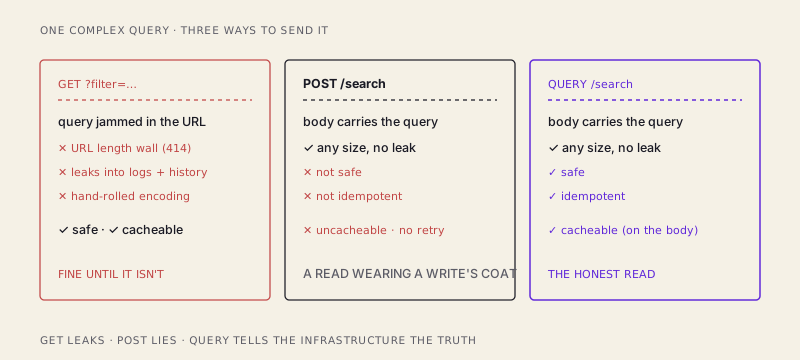
The obvious fix — "let GET have a body" — is a dead end, and not for a good reason, just an old one. RFC 9110 technically permits a body on a GET, but immediately warns that doing so has no defined meaning and will break things: caches, proxies, and libraries throughout the ecosystem were built assuming GET bodies don't exist, and many silently drop them. So a GET body is a trap. Which is how everyone ends up at POST.
What POST actually costs you
POST works. The body goes through. That's the whole appeal, and it's also where the honesty ends.
The word "safe" in HTTP is a technical term with teeth. A safe method is one the spec promises has no side effects the client is responsible for — a read, essentially. GET, HEAD, and OPTIONS are safe. A crawler will happily fire safe requests all day because it knows it isn't changing anything. Idempotent means making the same request twice has the same effect as making it once — so a client, proxy, or load balancer can safely retry it after a timeout without fear of doing the thing twice.
POST is neither. It's the method that specifically means "this might change something, and repeating it might change something again." So the entire infrastructure that speaks HTTP treats your POST /search accordingly:
- Caches refuse it. A
POSTresponse is essentially uncacheable by default. Your identical search from a thousand users can't be served from a shared cache, because the cache has no way to know the request was harmless. - Retries are dangerous. A proxy or client library will retry a timed-out
GETautomatically. It won't retry aPOST, because it can't tell your safe search from an unsafe "charge the card." So a blip becomes a user-facing error instead of a transparent retry. - The semantics lie. Anyone reading your access logs, your API, or your traces sees
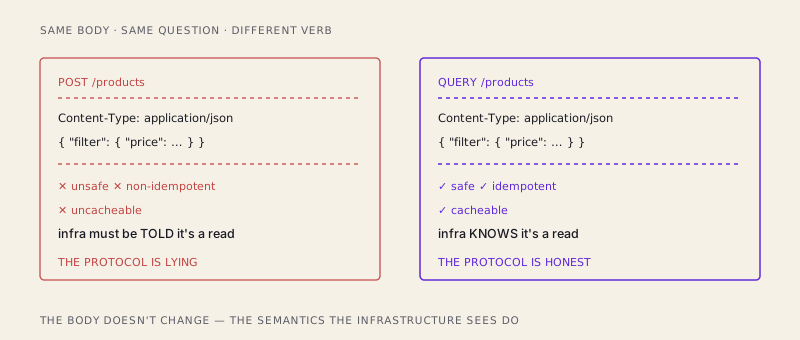
POST /searchand has to know, out of band, that it's actually a read. The protocol is no longer telling the truth about your system.
You didn't choose any of that. You chose it by elimination, because POST was the only method left standing that could carry the body.
What QUERY changes
QUERY is deliberately boring, and that's the point. Take everything good about GET and add the one thing it lacks.
A QUERY request is safe and idempotent — the spec says so, the same way it says GET is. So every retry policy, every crawler, every cache that special-cases safe methods can treat QUERY exactly like a read, because it is one. And a QUERY request carries a body, with a Content-Type that describes it. Your query is application/json, or a GraphQL document, or an SQL-ish DSL — whatever you want — sent as content, not smuggled into a URL.
QUERY /products HTTP/1.1
Host: api.example.com
Content-Type: application/json
Accept: application/json

{
  "filter": {
    "category": "keyboards",
    "price": { "gte": 40, "lte": 150 },
    "tags": { "any": ["mechanical", "wireless"] }
  },
  "sort": [{ "field": "price", "order": "asc" }],
  "limit": 50
}
No length ceiling. Nothing sensitive in the URL, so nothing sensitive in your access logs or browser history. No bracket-encoding convention to invent. And the method itself announces, to every piece of software on the path, that this is a safe, repeatable read.
The clever part: caching a request that has a body
Here's the piece that makes QUERY more than "POST with better manners," and it's the detail worth remembering.
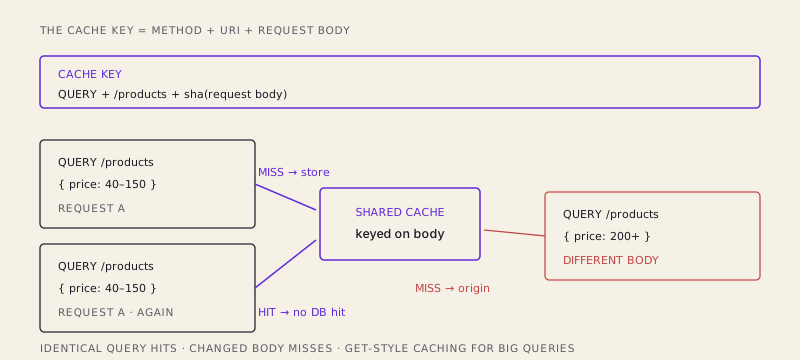
A normal cache keys on the method and the URL. That's why GET is cacheable and POST isn't — a GET's full input lives in the URL, so the URL is a complete cache key. But a QUERY's input is in the body. Two QUERY requests to the same /products URL can ask completely different questions. So a cache that ignored the body would be catastrophically wrong: it'd serve one user's search results to another user's totally different search.
QUERY's answer is that the request body becomes part of the cache key. A cache stores the response against the combination of method, URI, and the query content. Fire the identical QUERY again — same URL, same body — and a shared cache can return the stored result without ever touching your database. Change one filter and it's a different key, so you get a fresh result. You get GET-style caching for requests whose input was far too big and complex to ever fit in a GET.
The draft also lets the server point at the results with a Content-Location response header — effectively saying "the answer to that query also lives at this stable URL" — so a follow-up plain GET can fetch the same result the normal, fully-cacheable way. It's the bridge back to classic HTTP caching for the results themselves.
Will it replace POST? No — and that's the right question
QUERY replaces exactly one thing: the POST you use when you aren't posting. Search, filtered list endpoints, complex reporting reads, GraphQL-over-HTTP queries, any "give me data based on this complicated criteria" call. Everywhere your POST is a read wearing a write's coat, QUERY is the honest version.
It does not touch the POST that actually creates and mutates. Placing an order, sending a message, uploading a file — those have side effects, they're not idempotent, and POST is exactly right for them. Nothing about QUERY changes that. The line is simple: is this request a read? If yes, QUERY is what you were reaching for. If it changes state, it stays POST.
The honest caveat: it's a draft. Client libraries, server frameworks, proxies, and CDNs are only starting to grow first-class support, and until the whole path understands the method, an intermediary that doesn't recognize QUERY may reject or mishandle it. So this isn't "rewrite your search endpoints this sprint." It's "understand the shape of the fix, watch the draft, and know exactly which of your POSTs are lying." Because once you see it, you can't unsee it: half the POSTs in your codebase were always secretly a GET that just needed somewhere to put its body.
/share

Kishore K Sharma
Lead Full Stack Engineer | Java · Spring Boot · Distributed Systems · AWS | Building Scalable Cloud-Native Platforms