Redis: Five Patterns Beyond Caching That Earn Its Place in Every Service
Most teams use Redis for one thing and miss the four others. Rate limiting, distributed locks, idempotency, ephemeral session storage, and a serviceable job queue — each in a few commands, each replacing something heavier.
- #redis
- #backend
- #distributed-systems
- #infrastructure
- #patterns
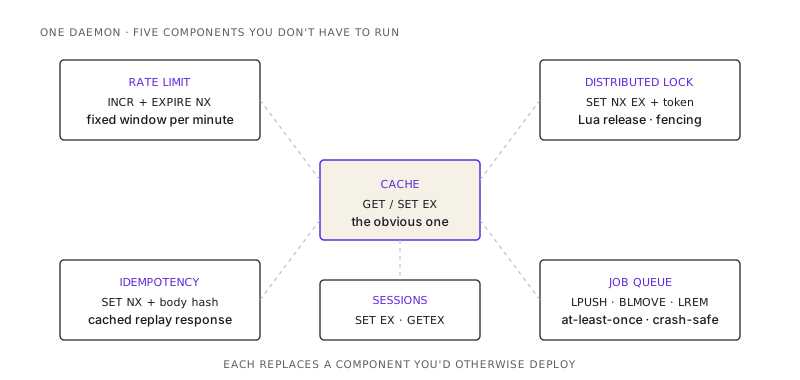
If the only thing your Redis instance does is cache database reads, you are paying for a Lamborghini and using it as a shelf. The cache hit rate is the first and most visible use, but four more patterns live in the same daemon and replace components that would otherwise be a much bigger lift.
This post is the five patterns I install on a Redis instance the day it stands up. Each is a small amount of code, each is production-shaped, each removes something you'd otherwise need a separate piece of infrastructure for. The pattern matters more than the language; I'll show the commands and one reference shape in Java/TypeScript where useful, but the primitives are the same regardless.
Why these five and not others
The patterns below survive a test most "you can do X in Redis" articles fail: would I actually use this in production, or is this a clever trick that breaks at the first network partition?
Five passed:
- Rate limiting with a fixed-window counter
- Distributed lock with a fencing token
- Idempotency keys
- Ephemeral session storage with TTL
- A serviceable job queue with
BLMOVEand a reliable-list pattern
The ones I left out — leaderboards, geo-radius queries, pub/sub for cross-service messaging — are real features, but they're niche enough that I'd evaluate them per-project. The five above earn the install in every service.
Pattern 1: Rate limiting with a fixed-window counter
The problem: prevent a caller from making more than N requests per minute. A token-bucket library is overkill for most services; a fixed-window counter in Redis does the job in two commands.
The shape: for each (client_id, current_minute), increment a counter, set a TTL the first time, reject if the count exceeds the limit.
KEY = ratelimit:user:42:2026-06-22T14:03
INCR KEY                   -> n
EXPIRE KEY 60 NX           -> sets TTL only on first call this minute
if n > LIMIT: reject
EXPIRE with the NX flag is the trick — it only sets the TTL if there isn't already one, so concurrent increments don't extend the window.
Reference implementation:
public boolean allow(String clientId, int limit) {
    String key = "ratelimit:" + clientId + ":" + currentMinute();
    long count = redis.incr(key);
    if (count == 1) redis.expire(key, 60);
    return count <= limit;
}
Caveat: fixed-window admits a "burst at the boundary" — a user could send limit requests in the last second of one minute and limit more in the first second of the next, briefly seeing 2× the limit. For most use cases this is fine. If you need stricter, the sliding-window log pattern (a ZADD + ZREMRANGEBYSCORE on a sorted set with timestamps as scores) gets you there at slightly higher cost.
Pattern 2: Distributed lock with a fencing token
The problem: ensure only one process at a time runs a critical section across N replicas of your service. Common case: don't let two workers process the same job.
The shape: SET key token NX EX seconds. If you got OK, you hold the lock. If you got nil, someone else does. To release, only delete the key if it still holds your token (otherwise you'd be releasing someone else's lock after your TTL expired).
acquire: SET lock:job-12345 <random-token> NX EX 30
release (Lua): if redis.call('GET',KEYS[1]) == ARGV[1] then return redis.call('DEL',KEYS[1]) else return 0 end
The token is non-negotiable. Naïve SET key 1 NX EX + DEL key is the classic broken lock — your TTL fires, someone else acquires, you finish, you DEL their lock. The token + conditional DEL (which has to be a Lua script for atomicity) closes the race.
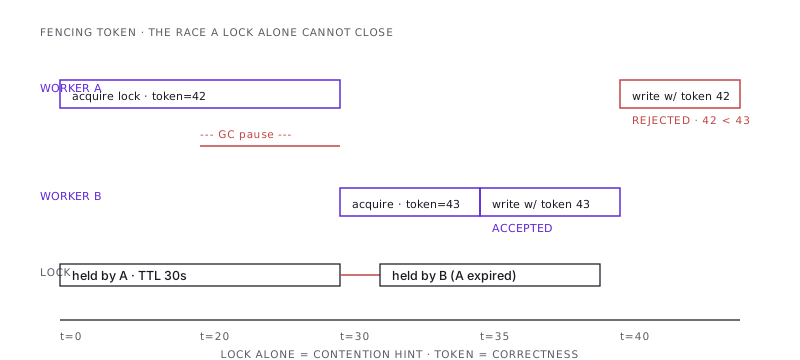
The fencing piece: the lock alone is not enough if the protected resource is on a different system. The canonical example: your worker holds the lock, GC pauses, lock expires, another worker acquires, original worker wakes up and writes to a database that knows nothing about Redis. The database happily accepts the late write.
The fix is the fencing token — an ever-increasing number you obtain alongside the lock (use INCR fence:job-12345), pass to the downstream system, and have the downstream system reject any write with a token lower than the highest one it's seen. The lock prevents contention; the fencing token prevents correctness violations during expiry races.
If your downstream can't accept a fencing token, the lock is a coordination hint, not a correctness guarantee. Know which kind you have.
Pattern 3: Idempotency keys
The problem: the same request lands twice — network retry, user double-click, upstream replay. You want the second call to return the result of the first, not re-execute the work.
The shape: the client sends an Idempotency-Key header. You hash the request body, store (key, body-hash, response), with a TTL long enough that retries within the realistic window get the cached response.
on request:
  SET idem:<key> "PENDING:<body-hash>" NX EX 86400
  if OK: process, then SET idem:<key> "DONE:<body-hash>:<response>"
  if nil: GET idem:<key> -> if PENDING, return 409; if DONE, return cached response
Two refinements you'll want in production:
- Verify the body hash matches. A request that arrives with the same
Idempotency-Keybut a different body is an attack or a bug — return 422, do not return the cached response. - Pre-claim the key before doing the work. Use the
PENDINGstate to mark "request being processed" — a second request that arrives before the first finishes can return a 409 Conflict, not start a duplicate execution.
This pattern replaces an "idempotency table" in your database for 90% of cases. The 10% where you still want the database: when you need to retain the record for audit purposes longer than Redis' realistic memory ceiling allows. For those, write to both.
Pattern 4: Ephemeral session storage with TTL
The problem: store per-session state without growing it forever. Sessions for web UI, magic-link tokens, password reset codes, email verification, anything with a "valid for 24 hours" window.
The shape: SET session:<id> <serialised-data> EX <seconds>. To extend on each request, use GETEX session:<id> EX <seconds> — atomic read-and-refresh. To revoke, DEL.
on login:        SET session:abc123 '<json>' EX 3600
on each request: GETEX session:abc123 EX 3600
on logout:       DEL session:abc123
Why not a database table: TTL is the killer feature. A session table requires a cleanup job, and most teams either skip it (table grows unbounded) or over-engineer it (cron + lock + monitoring). Redis evicts at TTL with no operational cost. The session data is correctly ephemeral.
Don't do this for anything you need to keep. Sessions in Redis are gone when the data store is gone. For session data that has audit requirements or post-expiry queryability, store the canonical record in your database and use Redis only for the active session lookup.
Pattern 5: A serviceable job queue with reliable-list semantics
The problem: you need a job queue. You don't want to deploy and operate a separate queue service (RabbitMQ, Kafka, SQS) for a workload that's small-to-medium and doesn't need exotic features.
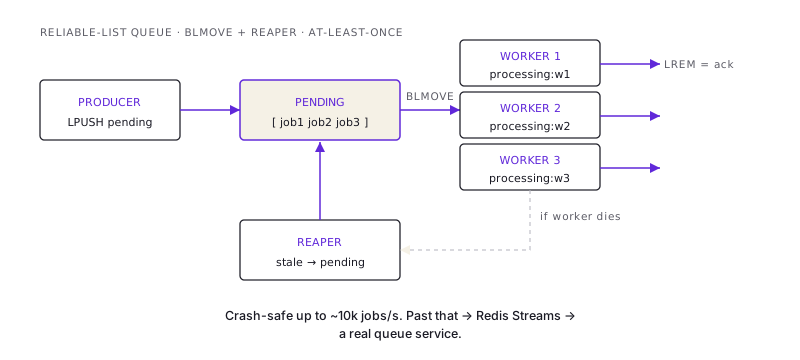
The shape: a producer LPUSHes jobs onto a pending list; workers BLMOVE jobs from pending to a per-worker processing:<worker-id> list (atomic remove-and-place); on success the worker LREMs the job from its processing list; on failure or worker death, a reaper moves jobs from stale processing lists back to pending.
producer: LPUSH pending '<job-payload>'

worker:
  job = BLMOVE pending processing:<wid> RIGHT LEFT timeout
  do work
  LREM processing:<wid> 1 '<job-payload>'    # ack

reaper (every N seconds):
  for each stale processing:<wid>:
    BLMOVE processing:<wid> pending LEFT RIGHT
BLMOVE is the right primitive — it atomically pops from one list and pushes onto another, and it blocks if pending is empty so workers don't have to busy-loop.
What this gets you: at-least-once delivery, parallel workers, crash-safe (jobs are recovered by the reaper if a worker dies mid-job), back-pressure (queue length is observable as LLEN pending).
What this doesn't get you, that a real queue would: fanout to multiple consumer groups, exactly-once semantics, multi-tenant queue isolation, audit logging, retry-with-backoff (you'd build it on top). For a single-tenant queue under ~10k jobs/second, this pattern is fine and saves you operating another piece of infrastructure. Past that, deploy a real queue.
A note on Redis Streams: Streams are the "real" Redis queue feature — consumer groups, ack semantics, pending entries list. If you're already past the simple-list pattern's limits, Streams are the next stop before adopting a separate queue service. The list pattern above is the minimum viable queue on Redis; Streams are the good-enough queue on Redis; a real queue service is the next tier.
The patterns share a property
Every pattern above is one or two commands, optional Lua for atomicity, no client-side state. That's not an accident. Redis is at its best when the operation can be expressed atomically on the server. The moment you find yourself reading-then-writing from the client without WATCH/MULTI/EXEC or a Lua script, you have a race condition.
The mental check before adopting any new Redis pattern: can the entire critical section run on the server in one atomic operation? If yes, you have a sound Redis pattern. If no, you either need Lua, or you're using Redis as a substitute for a real database and you'll regret it.
What to monitor
Whatever patterns you use, the operational picture for a Redis you depend on:
- Hit rate (only for cache use):
info stats→keyspace_hits / (keyspace_hits + keyspace_misses). Under 80% means your cache is mis-sized or mis-TTL'd. - Memory usage and eviction count: if
evicted_keysis non-zero and growing, yourmaxmemory-policyis doing surgery without anaesthesia. Either grow memory or fix the keys that shouldn't be there. - Connection count: connection storms (client without pooling) saturate Redis surprisingly fast. Cap on the client side.
- Slow log:
slowlog get 10will show you any single command over 10ms — these are usually bigKEYScalls, bigHGETALLon a fat hash, or a Lua script someone wrote without thinking. Fix or remove.
If those four are clean, your Redis is healthy regardless of which patterns you've adopted on top.
When to outgrow Redis
Honestly: when you need cross-region replication with strong consistency, when your dataset doesn't fit in memory and you can't accept the latency of paging, or when a single-master architecture stops cutting it. Redis Cluster handles horizontal scale but has caveats (cross-slot operations fail; some patterns above need the keys to hash to the same slot, which means tagging the keys with {...} braces).
For most services, the day you outgrow Redis is the day your service is interesting enough to warrant a proper sit-down with the platform team about what comes next. Until that day — and that day is much further out than people assume — five patterns on one daemon does more than people give it credit for.
/share

Kishore K Sharma
Lead Full Stack Engineer | Java · Spring Boot · Distributed Systems · AWS | Building Scalable Cloud-Native Platforms