The Art of Debugging: A Step-by-Step Guide to Finding the Root Cause
Debugging is not a dark art; it is a systematic process of elimination. Here is my proven framework for tracking down any bug.
- #debugging
- #engineering
- #process
- #culture
Every developer knows the feeling. A user reports a catastrophic error in production, the Slack channels are lighting up, and you are staring at a stack trace that looks like an ancient dialect. In moments like these, panic is your worst enemy, and methodology is your best friend.
Over the years, I've realized that debugging is not about having a sixth sense for code; it is a systematic process of elimination. If you follow a strict framework, you will eventually find the bug, no matter how obscure it seems.
Here is the step-by-step process I use to track down and neutralize complex software issues.
1. Do Not Guess. Reproduce.
The most dangerous phrase in debugging is "I think I know what's wrong." Guessing leads to random code changes, which introduces new bugs while failing to fix the original one.
Your very first goal is to reproduce the issue locally or in a staging environment. If you cannot reproduce it, you cannot verify that you have fixed it.
Gather all the environment details: OS, browser, user state, and exact steps. If it only happens in production, check your structured logs to recreate the exact payload that triggered the failure.

2. Read the Actual Error (Out Loud if Necessary)
It is shocking how often we glance at a red wall of text in the console and immediately open Google or StackOverflow. Stop. Read the error message. Read it carefully.
Often, the compiler or interpreter is telling you exactly what is wrong and exactly which line it happened on. Trace the error back to the exact file and line number in your own codebase before you look for external help.
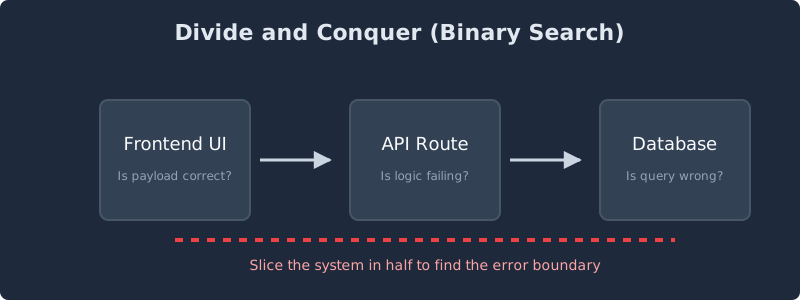
3. The "Divide and Conquer" Technique
When an entire system is failing and you don't know where to start, cut the system in half. This is essentially a binary search for bugs.
If a web page isn't submitting data properly:
- Check the Network tab. Is the frontend sending the correct payload?
- If no, the bug is in the React/UI code.
- If yes, check the API layer.
- Is the API receiving the payload and failing before hitting the database?
- If yes, the bug is in your business logic.
- If no, check the database query logs.
By continually isolating the fault line, you turn an overwhelming architecture into a tiny, manageable function.
4. The Rubber Duck Method
When you have isolated the function but the logic still isn't making sense, it is time to talk to the duck.
Explain what the code is supposed to do, line by line, to an inanimate object (or a patient coworker). In the process of translating complex logic into spoken language, your brain is forced to process the information differently. More often than not, you will hear yourself say something obviously incorrect, and the bug will reveal itself.
A Quick Example
Imagine a bug where an API returns a 500 error randomly.
// The Buggy Code
function calculateDiscount(user) {
  // If user has no orders, this throws an error!
  const lastOrderPrice = user.orders[user.orders.length - 1].price;
  return lastOrderPrice * 0.1;
}

// The Fix
function calculateDiscount(user) {
  // Defensive programming saves the day
  if (!user.orders || user.orders.length === 0) {
    return 0;
  }
  const lastOrderPrice = user.orders[user.orders.length - 1].price;
  return lastOrderPrice * 0.1;
}
5. Fix the Root, Not the Symptom
Finally, once you find the line of code that caused the crash, ask yourself why it failed. Did a null value get passed in? Why was it null? Where did that data originate?
Always aim to fix the root cause, not just patch the symptom. Add defensive programming, write a unit test to prevent regression, and document your findings. Debugging is painful, but learning from it ensures you never have to fix the same bug twice.
/share

Kishore K Sharma
Lead Full Stack Engineer | Java · Spring Boot · Distributed Systems · AWS | Building Scalable Cloud-Native Platforms